
Running a Session
How to run a session.
What a session looks like, what you need to run one, and how to keep it safe - for schools, clubs and holiday camps.
What is a sport wheelchair, and how is it different from an everyday one?
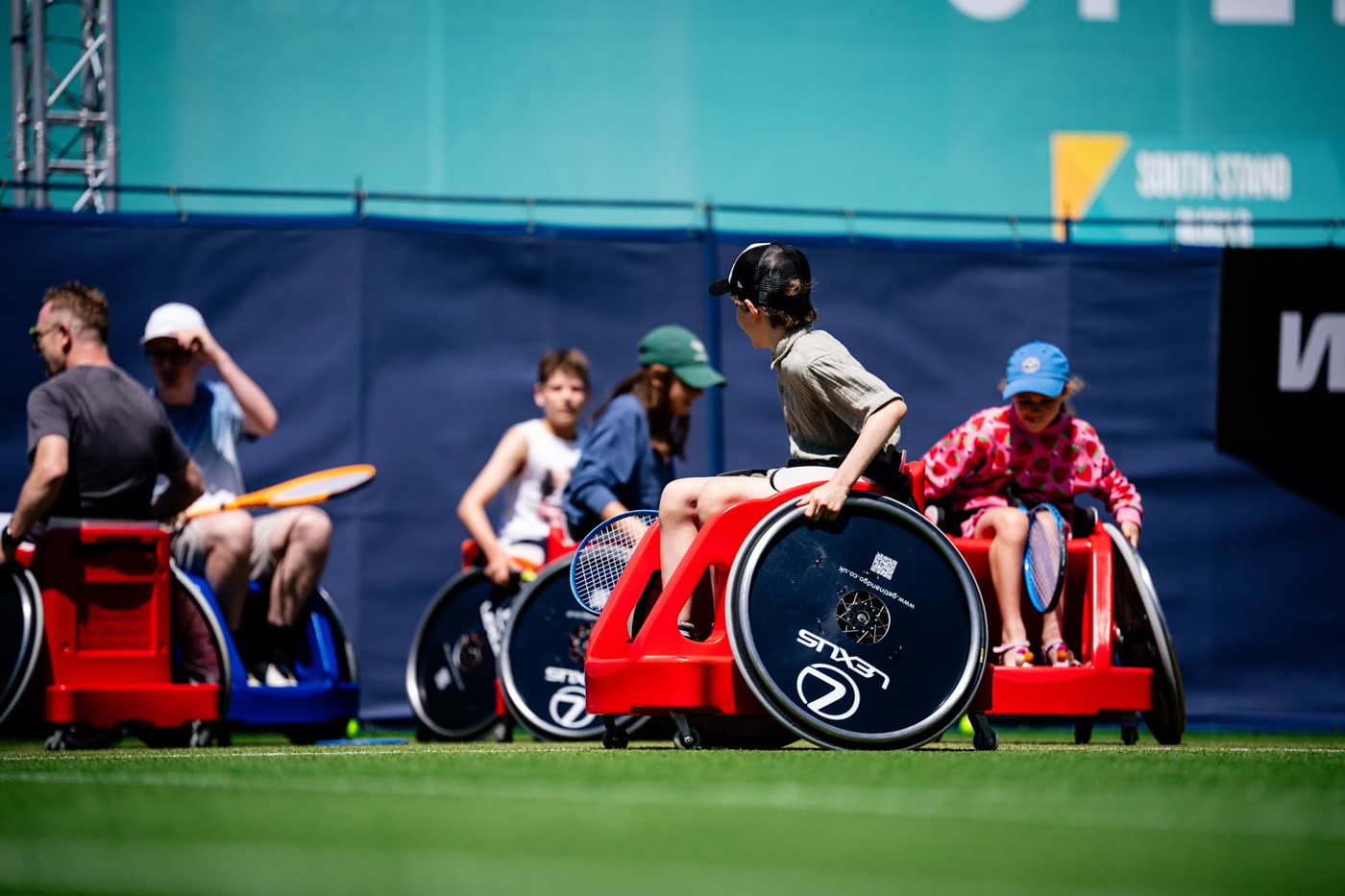
An everyday wheelchair is built for getting around. A sport wheelchair is built for playing - it turns quickly, it takes knocks, and it is stable when a child moves fast in it.
The chairs we hire are entry-level by design. They are not the highly specialised chairs elite wheelchair athletes use, which run to thousands of pounds - ours cost around five times less, which is what makes hiring a set viable in the first place. They are plastic-moulded, they have an extra point of contact so they do not tip, and children can knock into each other without damaging the chairs or themselves.
They are built for ages 8 to 16, and for more than tennis - handball, rugby and basketball all work, so one delivery covers a range of sessions.
Read the transcript
This chair is pretty unique for a fair few reasons. Number one, it's lightweight. When you've got loads of different kids with all mixed abilities going in a wheelchair for potentially the first time, you need it to be lightweight. You want it to not be a really heavy piece of equipment. So this is perfect for a youngster to be involved.
Number two, it's simple. And what I mean by that is the only thing you have to worry about is putting the wheels on and off.
Another reason why these chairs are great and fit for purpose is it's durable. Obviously you're going to have quite a few kids jumping in and out of them potentially. They're going to be maybe crashing into each other. You want them to be able to last the session and be able to put up with the wear and tear. Let's say this chair is for that.
And finally, they're really easy to stack. You can pack them up one by one. So for storage space, the maintenance and containing the chairs for a short space of time, they're great for that as well.
The process is really simple. You book online, we'll deliver them to you. You have your fun for a week, two weeks. And at the end of that, we'll collect them off you. And by taking all the stress of transportation, managing the chairs, maintenance of the chairs, we hope that it encourages more schools, more clubs, more centres across the UK to get more children involved and have the opportunity of being in a wheelchair and know what it feels like.
How do I include wheelchairs in my usual PE lesson?
The short answer is that you probably do not need to redesign the session. Get In And Go is built to drop into the activity you already run, not to sit next to it as a separate thing. Carry on with what you had planned - the difference is that some of the group move in chairs rather than on foot.
That is why a set is hired rather than a single chair. With eight chairs in the room, being in one is simply what the lesson is that day - the whole group is doing the same activity, on the same terms, and nobody is singled out either way.
It works across the sports you already teach - tennis, handball, rugby and basketball - so it fits into a scheme of work you have planned rather than replacing it.
What does a session actually look like?
The same length as the sessions you already run - 30 to 60 minutes, the length of a normal PE lesson. It fits your existing timetable, for as long as you have the chairs.
A standard booking is eight chairs, and most groups are in the mid to late twenties, so that works out at one chair between two or three children. Do not put everyone in chairs at once. Split the group: half work in the chairs while the other half does something else, not necessarily seated, and then they rotate. That keeps it manageable for one member of staff.
Within the chairs, work in pairs. Once children can wheel confidently, the simplest progression is a feeding drill - one child bounces or feeds a ball, the other moves towards it and catches. Everything builds from being able to move and receive at the same time.
Read the transcript
My name is Lee Neale and I'm a tennis coach and wheelchair specialist. These next three drills are something I'd recommend to all entry-level players regardless of the sport. It's a really, really good warm-up.
So regardless of the sport, your basic pushing technique is the same. Put your hands 12 o'clock here. These are the push rims. You can either hold the push rims or, like myself and like Alfie, hold the wheel and the push rim. The push rims are nice and close to the wheel so your fingers can't get caught in there.
At the start of each session I would do something along the lines with pushing, which is the most important part of wheelchair sport. First thing would be a simple push to the other side, get around the cone and get back as quick as I can. This could be done with able-bodied children or just with wheelchair players, as a relay or just as a straight time to see how quick I could do it. Here we go. Three, two, one, off.
And one more time. So on this one, it's a recovery drill. So I'm going to try and get back to the centre each time. I'm going to go around the blue, back to the centre, around the red. I'm going to try that a couple of times and see how I do. Go! Try and get as close to them as I can. Around the outside. Ooh, caught a bit fine there. Okay. Back to the centre to finish.
Now I'm going to run the exact same drill, only this time when I hit the recovery back here my colleague standing right there is going to shout the colour. It could be blue, it could be red. So there's an element of decision making and turning. I might have to turn back on myself. This really mimics a live match, as close as I can to playing in a live match. So blue to start, and then my colleague Nicole. Red. Blue. Blue.
On all the drills, if you could see, I was pushing around the outside. So if I'll do that again, pushing around the outside of the cone, which means I'm recovering back to the centre of the tennis court, which you will see pro players do. If I went this way, I went around the outside of the cone. That's really important.
What do I need to run one?
Space
Wherever you already run activities. A sports hall, a playground, a tennis court or outside all work, and there is no minimum size. The chairs handle any surface - a harder, smoother one is easier to wheel on, which matters most for the youngest children.
Staff
One member of staff can run a session alone. The videos cover everything from putting a chair together safely through to basic drills, so no specialist qualification is needed.
Equipment
Just what you already use. The chairs arrive with wheels, wheel pins, safety belts and padding - nothing else is needed, and there is no special-sized kit to buy.
One practical thing worth knowing. The tyres arrive inflated to 110 PSI. That is higher than most people expect, and it is what makes the chairs roll properly - so if you have a pump on hand it is worth checking them before a session.
The padding inside each chair can be taken out to suit smaller or larger children, though most leave it in.
Do you need a coach? No - the material is made so that your own staff can deliver a session without one. We do have coaches around London, Manchester and Leeds, and we are building that out as an optional extra at the start of a rental. It is not something we can offer on every booking yet, so ask when you enquire and we will tell you honestly whether we can cover you.
Is it safe, and what should I check?
The chairs are designed to be forgiving - the extra point of contact means they do not tip, and the moulded body means a collision between two children is a bump rather than an incident.
There are two checks to make before any child moves, every time:
- 01The wheels are clicked in. Each wheel is held by a pin. Check it has engaged properly rather than assuming it has.
- 02The safety belt is on and the child is secure in the seat.
Both are quick, and both matter. The realistic risk in a session is a child wheeling fast without their belt fastened and coming out of the chair - that is the one thing worth being strict about.
Read the transcript
Hi, I'm Lee Neale. I've been a tennis coach for about 20 years. Before that, a teacher. I've been involved in wheelchair tennis for about 10 years, delivering both juniors and adult wheelchair tennis.
I would like to introduce you to this PlayMoovin' wheelchair, which is a brilliant wheelchair as an introduction to wheelchair tennis, badminton, rugby, anything that you want. I recommend this chair because it's easy to use, robust, great for entry-level sports. These chairs are amazing for PE lessons.
So simple to put together. First, we have the two large wheels. Take them off. As you can see, there's four casters. So it's really rock solid already. I haven't even put the wheels on.
Take the large wheels. Push the centre pin, which is there. Slide in. Here we go. Release. Solid. Spin the chair. Press the centre pin again. Slide into the hole. Release. Perfect. Ready to go.
How far ahead do I need to book?
Enquire at least two to three weeks before your dates. You cannot book instantly through the site on purpose - we talk each booking through, because availability depends on where the chairs currently are and how quickly they can be turned around.
Between bookings every set comes back to the warehouse to be cleaned and safety-checked before it goes out again. That turnaround is the reason for the notice period rather than any paperwork at your end.
If your dates do not work, tell us anyway - we would rather find you an alternative than turn the enquiry away.